Sunday, May 31, 2015

SPACE

Space, the great beyond, the final frontier, its size is unlike anything we could ever fathom. For eons, we have had our heads in the stars, wanting to understand what lies past the blue skies of Earth and what it meant for the future of mankind. We started by observing what we could by means of mapping out the stars and observing them with telescopes to make conjectures that would later serve to aid us when we actually were able to get lift-off from the Earth’s surface. Much time has passed and we have more sophisticated technology to help us observe the cosmos, but even so, the universe is far too big and our lives are far too short to be able to define its entirety. But, with such great size comes room for imagination!


Physical art can be made off of the planet in zero gravity conditions. Sculptures, for example, are tethered to the Earth due to gravity, but in areas of little to no gravity, sculptured may be created to be viewed from all conceivable angles. Other artists have taken interest in the objects orbiting around our planet such as Richard Clar’s project Collision II where he creates ‘collisions’ by using calculations of debris in the Earth’s orbit to generate images and music that correspond with their movements.


Many films and television series have also been made about the possibilities of what can happen in space as you may have seen on show like in sci-fi shows such as Star Trek or cartoon/comedies like Futurama. Often these shows do not follow common logic of the physical properties of non-Earth environments, but they do offer a fantastic escape to a world far from the one we inhabit.


sources:
 "BAM/PFA - Audio & Videocasts." BAM/PFA - Audio & Videocasts. Web. 1 June 2015.
"Bonestell - Home." Bonestell - Home. Web. 1 June 2015.
"Dancing on the Ceiling: Art & Zero Gravity Curated by Kathleen Forde : EMPAC Curtis R. Priem Experimental Media and Performing Arts Center : Troy, NY USA." Dancing on the Ceiling: Art & Zero Gravity Curated by Kathleen Forde : EMPAC Curtis R. Priem Experimental Media and Performing Arts Center : Troy, NY USA. Web. 1 June 2015.
"Space Art Projects at Art Technologies, a Collaboration between Space Technology and the Arts." Space Art Projects at Art Technologies, a Collaboration between Space Technology and the Arts. Web. 1 June 2015.
"Cosmic Dancer - a Space Art Intervention by Arthur Woods." The Cosmic Dancer Project : Sculpture And Gravity : Arthur Woods. Web. 1 June 2015.  

Sunday, May 24, 2015

nanotetch


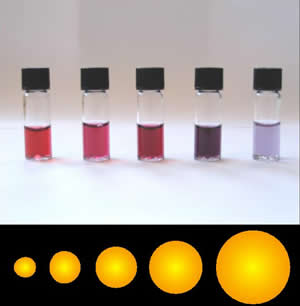
Nanoparticles are tiny. Very tiny, in fact. It is only until quite recently that we have been able to even see them with the invention of the scanning electron microscope. It turns out that nanoparticles are around the size of a molecule of glucose, around twenty-four atoms big. The properties of elements at the ‘nanometric’ level are much different than those at their common sized state, in fact their properties are sometimes even opposite. For example, an element that is normally solid and relatively inert could be liquid and very flammable when nano-sized.


The properties of elements and compounds at the nanoscale level have undergone much experimentation and they have many useful applications that can affect us in our everyday lives. We can see how the effects diesel exhaust affects our lungs at a nanoscale level. Nanoparticles can be used to detect clots in arteries to the point of the exact location for an immediate response. They have even used nanoparticles as a cheaper and efficient means of detecting HIV and cancerous cells. The knowledge of these properties is still new and much more research has to be done to know what is safe to put into our bodies and how nanoparticles react. Hopefully nanotechnology will revolutionize medical treatments and diagnostics for our betterment!


sources:
 "DNA Folding, in Detail." Paul Rothemund:. Web. 22 May 2015.
"Findings on Pollution Damage." Web. 22 May 2015.
"New Nanoparticles Make Blood Clots Visible." Web. 22 May 2015.
"Programmable Bio-Nano-Chip as Medical Diagnostic Tool." Web. 22 May 2015.
"World's First Programmable Nanoprocessor." Web. 22 May 2015.  

Sunday, May 17, 2015

Neuroscience + arthttp://i46.tinypic.com/29uqd8z.jpg

The topic of the brain has fascinated mankind for quite some time now. Today, we have many forms of technology to aid in our quest to figure out what is happening in our crania. In the project that created Brainbow, neurons were ‘painted’ with fluorescent colorings to show how they are connected to one another, which is important for understanding how they interact to different stimuli.


With the use of modern MRI scans, it is now possible to see different parts of the brain react to different stimuli in real time as opposed to waiting days and months for the data to be analyzed. Christopher deCharmes describes how this technology can be used to relieve chronic pain by knowing which part of the brain is causing the pain and correcting it from there rather than focusing on that specific body part.


A UCLA study showed that people who meditated 10-90minutes each day say it is an essential part of working in their field. Through deep concentration, they are able to focus on how to heighten their precision in their work. They also showed signs of reduced stress and better immune systems. They are still unsure of where exactly in the brain reacts to meditation.


It is a bit strange to think that we have been using our brains to study our brains and we still do not know all there is to know! With better technology surfacing every day, we will be able to find out more and more about ourselves in the near future!


sources:
 "3 Clues to Understanding Your Brain." VS Ramachandran:. Web. 18 May 2015.
"A Look inside the Brain in Real Time." Christopher DeCharms:. Web. 18 May 2015.
"How to Build a Bigger Brain." How to Build a Bigger Brain. Web. 18 May 2015.
"Neuroscientist Helps Pave Way for Dalai Lama's Visit." Neuroscientist Helps Pave Way for Dalai Lama's Visit. Web. 18 May 2015.
Vesna, Victoria. "Neuroscience-pt1.mov." YouTube. Web. 18 May 2015.  

Sunday, May 10, 2015

биотек и арт

Not going to lie, this week’s topic and videos made me a bit uncomfortable, but important nonetheless.

In our lecture videos, we were exposed to the idea of physically and genetically altering life forms for various purposes. This concept, as seen in the glowing rabbits, was an important step for humans figuring out how to alter physical traits in organisms and in this case, it was rather harmless. But as we saw with the butterfly with the holes in its wings, these alterations can have serious repercussions, which is why we should not take them lightly. We also saw Joe Davis’ genetically engineered bacteria, Microvenus, and while it is immensely popular, we see that it is not displayed anywhere due to public unease.


Genetically modifying our food is another example of public controversy over bioengineering, this time because it relates directly to what we put in our bodies. GMO in foodstuffs is a bit of a double-edged sword. We can control the degree of variation in each banana and if it has fewer problems than non-GMO counterparts, we can better control its production, health risks, how water-friendly they are, etc. The problem is that when things go awry, GMOs can be life threatening. They can also be dangerous to an environment because they can be so successful at reproducing that they invasively destroy native species and cause all sorts of chain reactions that snowball into chaos.


While I personally do not really see the value of altering other conscious organisms for purposes that do not directly relate to their health, the altering of one’s own body as a means of self-expression is much more understandable to me. Whether it means engineering another ear into your skin, or changing your gender, it’s your body and your choice what to do with it.

sources:

 "GFP BUNNY." GFP BUNNY. Web. 11 May 2015.
"POV | Food, Inc. | Interview with Michael Pollan | PBS." YouTube. YouTube. Web. 11 May 2015.
"Seed Magazineabout." Wanted: GM Seeds for Study § SEEDMAGAZINE.COM. Web. 11 May 2015.  
 "Super Weed Can't Be Killed." ABC News. ABC News Network. Web. 11 May 2015.
"'Super Weed' Taking Strong Hold in Utah | KSL.com." 'Super Weed' Taking Strong Hold in Utah | KSL.com. Web. 11 May 2015.