Saturday, June 6, 2015

Event 3: da hamma

This last week, I took my first visit to the UCLA Hammer Museum. Never having been there, I of course had to spend my first half an hour playing on the fun rolling chairs they had in the atrium. After that I took a stroll through the painting gallery and listened to a few stories about how people that had their portraits done way back when were the ones with the largest egos because of how expensive and time-consuming they were. But finally after all of that I went to the only other open gallery room that wasn’t undergoing changes in exhibits.


In this gallery was a small corridor that led to an exhibit titled This is the End. A curios title deserves to be explored and the corridor led to a room with a movie projected onto a screen and ~bean bag chairs~ to sink into. The exhibit cycled through three short films by three different artists that each presented on topics in an unconventional and surrealistic manner. The film I saw was titled Even Pricks by Ed Atkins, which explored the physical and emotional manifestations of depression.


The film used digitally rendered images of a monkey, a man’s arm, and a bed as the main focus points. Not much was said, but when there were words they sounded mostly like gibberish. The part that really spoke to me was the man’s arm, which held a thumbs up. Things would happen to the thumbs up such as the arm twisting to make it a thumbs down, or the thumb would deflate, re-inflate, eventually explode, get rained on, etc. They all played a part in showing the viewers that the mental well-being and happiness of a depressed individual is as unpredictable as weather, taking wild turns from severe anxiety to sudden bliss then back to anxiety. It was really fascinating to see the beautiful CGI effects being used not just to show things other than sci-fi and popular media, but for art concerning our mental health. I am excited to look up other pieces by Atkins and others that explore other deep themes!

EVENT TWO: GHETTY ME OUTTA HERE 4/19

Hahaha, but seriously The Ghetty Center was very packed that Sunday. Nevertheless,  I did not let that get in the way of me enjoying this wonderful place for the first time! I was not sure what I was going to write about when going here, so I walked around and looked at all of the art chronologically and made some observations.


The first pieces I saw were dated before 1400AD and it was quite apparent that the concept of perspective was not very widespread as most paintings were very two-dimensional and mostly had religious scenes where the people mostly had profiles of faces. It was not until I walked around paintings dated around 1600 that I saw Brunelleschi’s influence on perspective reach nearly all of the paintings. After this point the paintings became more and more realistic; all of the faces had every wrinkle noted perfectly and each bowl of fruit looked quite appetizing.


The architecture of The Ghetty Center itself is a sight to behold. It is very clear that the architecture was carefully designed to really take advantage of the ever-shining Los Angeles sun with walls of glass and louvers to capture the natural and quite plentiful light. Some parts of the building’s exterior reflect a golden ratio-esque theme. I also marveled in the beautiful contrast between the natural mountainous surroundings to the north and the glorious view of the city to the south which made me think of the theme of this class: The mountainous landscape representing the artistic beauty, the city view representing scientific achievements, and the museum itself showing both joined together to create a utopia where both aspects thrive off of each other, which I thought was pretty dang cool. I hope everyone gets the chance to visit The Ghetty Center; I know I want to return to see everything that I missed!

(golden rectangle????)

Tuesday, June 2, 2015

Event 1 ArtSci at CNSI 5/12

(I'm sleathily taking a photo in uniform which is forbidden -thunder and lightning-) 

While between shifts, I had just enough time to check out an ArtSci exhibit at our very own California Neuroscience Institute in south campus! I was only able to stop by for around twenty minutes, but it was plenty of time to read through all the pieces! The honorable mentions include a map where everyone was prompted to trace out their walking path of the day on a map of campus using yarn and map pins, and a neat piece with sections of the brain displayed with flip-book paper pieces that people had drawn on.


The piece I found the most intriguing, was Rahul Iyengar’s “Origins”. Mr. Iyengar was not present while I was at the exhibit, but he did leave a nice description next to his piece. It had three images with different swirls on them: one that represented the golden ratio, one with an ammonite fossil, and one with fractal spirals. Each piece has inspirations from the golden ratio spiral that we saw in our lectures, as it appears in natural circumstances such as weather patterns, nautilus shells (to an extent), etc. He noted that the swastika is also similar in appearance, but in the context that in Hindu, it represents the creation of the universe and the “arms of time.” I found the last comment very fascinating considering that it is a very taboo symbol in our culture, so it was nice to see it from a different (and much more pleasant) perspective!

Sunday, May 31, 2015

SPACE

Space, the great beyond, the final frontier, its size is unlike anything we could ever fathom. For eons, we have had our heads in the stars, wanting to understand what lies past the blue skies of Earth and what it meant for the future of mankind. We started by observing what we could by means of mapping out the stars and observing them with telescopes to make conjectures that would later serve to aid us when we actually were able to get lift-off from the Earth’s surface. Much time has passed and we have more sophisticated technology to help us observe the cosmos, but even so, the universe is far too big and our lives are far too short to be able to define its entirety. But, with such great size comes room for imagination!


Physical art can be made off of the planet in zero gravity conditions. Sculptures, for example, are tethered to the Earth due to gravity, but in areas of little to no gravity, sculptured may be created to be viewed from all conceivable angles. Other artists have taken interest in the objects orbiting around our planet such as Richard Clar’s project Collision II where he creates ‘collisions’ by using calculations of debris in the Earth’s orbit to generate images and music that correspond with their movements.


Many films and television series have also been made about the possibilities of what can happen in space as you may have seen on show like in sci-fi shows such as Star Trek or cartoon/comedies like Futurama. Often these shows do not follow common logic of the physical properties of non-Earth environments, but they do offer a fantastic escape to a world far from the one we inhabit.


sources:
 "BAM/PFA - Audio & Videocasts." BAM/PFA - Audio & Videocasts. Web. 1 June 2015.
"Bonestell - Home." Bonestell - Home. Web. 1 June 2015.
"Dancing on the Ceiling: Art & Zero Gravity Curated by Kathleen Forde : EMPAC Curtis R. Priem Experimental Media and Performing Arts Center : Troy, NY USA." Dancing on the Ceiling: Art & Zero Gravity Curated by Kathleen Forde : EMPAC Curtis R. Priem Experimental Media and Performing Arts Center : Troy, NY USA. Web. 1 June 2015.
"Space Art Projects at Art Technologies, a Collaboration between Space Technology and the Arts." Space Art Projects at Art Technologies, a Collaboration between Space Technology and the Arts. Web. 1 June 2015.
"Cosmic Dancer - a Space Art Intervention by Arthur Woods." The Cosmic Dancer Project : Sculpture And Gravity : Arthur Woods. Web. 1 June 2015.  

Sunday, May 24, 2015

nanotetch


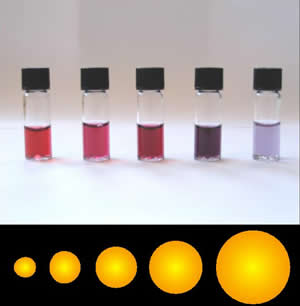
Nanoparticles are tiny. Very tiny, in fact. It is only until quite recently that we have been able to even see them with the invention of the scanning electron microscope. It turns out that nanoparticles are around the size of a molecule of glucose, around twenty-four atoms big. The properties of elements at the ‘nanometric’ level are much different than those at their common sized state, in fact their properties are sometimes even opposite. For example, an element that is normally solid and relatively inert could be liquid and very flammable when nano-sized.


The properties of elements and compounds at the nanoscale level have undergone much experimentation and they have many useful applications that can affect us in our everyday lives. We can see how the effects diesel exhaust affects our lungs at a nanoscale level. Nanoparticles can be used to detect clots in arteries to the point of the exact location for an immediate response. They have even used nanoparticles as a cheaper and efficient means of detecting HIV and cancerous cells. The knowledge of these properties is still new and much more research has to be done to know what is safe to put into our bodies and how nanoparticles react. Hopefully nanotechnology will revolutionize medical treatments and diagnostics for our betterment!


sources:
 "DNA Folding, in Detail." Paul Rothemund:. Web. 22 May 2015.
"Findings on Pollution Damage." Web. 22 May 2015.
"New Nanoparticles Make Blood Clots Visible." Web. 22 May 2015.
"Programmable Bio-Nano-Chip as Medical Diagnostic Tool." Web. 22 May 2015.
"World's First Programmable Nanoprocessor." Web. 22 May 2015.